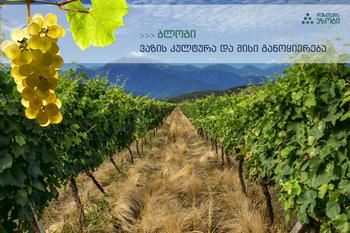
Vineyards are widespread almost in all regions and about 360 species of vine are grown successfully in Georgia. Vine-growing is one of the leading fields of agricultural development of Georgia.
because of appropriate soil and climate Each of the Vine species that are grown in Georgia has its typical taste property and aroma, conditions, fertilization and specific treatment, so high quality half sweet and fortified wines are received, also these species are good materials for blending wines.
Vine requirements for nitrogen fertilizers
Vineyards are grown at the same place for 30-40 years, so nutrients content of the soil becomes poor. Vines are grown on almost all kinds of soil, but especially structural soft types, rich in humus carbonated soils give richer and good of quality products.
Vineyards that are grown on acidic and salt marsh soils are less productive, so acidic soils should be treated with lime or lime contented ores, e.g. Marl. Gypsum treatment or other land improvement measures are required for salt marsh soils.
Re-utilization of nutrient elements is special biological property of vine
When there is nitrogen deficiency in the soil, a vine reduces growing, older leaves get sick with chlorosis (become yellow), quality of grape and wine decreases sharply; when there is excess nitrogen in the soil vegetative organs of a vine grow fast, get diseases easily, develop grape with high acidity and low sugar level that ripen late, decreases quality and commodity value of wine.
In vegetative period for nutrient taking process from the soil vine needs rather long time. Vine takes nitrogen form the soil faster in flowering period. Less nitrogen is taken up from the soil by early season grape than late season grape. About 39, 7 kilos of nitrogen is taken from 1 hectare of area for 100 centner of grape yield.
Nitrogen norm should be differentiated according the irrigated and non irrigated conditions of east and west Georgia. For non irrigated lands of Kakheti 45-90kg/ha of nitrogen application is recommended. Physical weight of ammonium nitrate application is 130- 261 kg but 214-428kg of ammonium sulfate is recommended.
For irrigated vineyards of Kartli and Kakheti 60-120 kg/ha of nitrogen application is recommended, physical weight of ammonium nitrate is 172-348kg while ammonium sulfate physical weight is 286-571 kg .
In regions with temperate precipitation conditions 90-150kg/ha of nitrogen application is required. Physical weight of ammonium nitrate is 261-435 kg, but ammonium sulfate physical weight is 428-714 kg.
Special attention is required when using nitrogen in high norms (150kg/ha), as excess norm of nitrogen impacts negatively on bud germination and generative development.
When grape yield is 70-100centner /ha, nitrogen norm increasing more than 90kg is not recommended, also more than 120 kg of nitrogen application is not required for 100-150centner /ha of grape yielding.
Fertilization of a young vineyard with nitrogen fertilizers should be carried out just from 3-4 years with norm of 30-40kg of pure nitrogen.
For fertilization of a fructifying vineyard with optimal norms, first of all agro-chemical properties of the soil should be determined, also soil moisture ,nutrient content of a plant leaves, level and quality of grape yield of the last year should be taken into account. 60% of nitrogen fertilizers are applied in the spring before re-plough the soil, when vegetative period starts. Ammonium nitrate application is appropriate to nourish plant when there is nitrogen deficiency.
© copyright