For developing of plant nourishment and fertilization system, first of all we have to take into account that demand of different kinds of crops for nutrient materials are not similar because of their biological characteristics. Quantity of nutrient materials which is taken by a plant from the soil is depended on many conditions: plant varieties, soil characteristics, climate, crop rotation, level of agro technical actions, irrigation regime, norm of applied fertilizers, application terms and techniques and etc.
Demand for nitrogen fertilizers by crops is depended on nutrient consumption period. The shorter is the absorption period of nutrient element by a plant, the plant demand is more for enough reachable form of element content in the soil and on the contrary.
All kinds of nitrogen fertilizers are divided for five groups by their dependence on nitrogen form. Now we are discussing agro technical characteristic of nitrogen fertilizers that are more common.
Ammonium Nitrate: nitrogen content-at least 34,5%, moisture max-0,2; ammonia part of nitrogen remains in the soil and doesn’t leach, while nitric part is free and movable ,so it may be leached; it makes the soil acidic; it is more applicable for base-rich non-acidic soils, or in case of lime treated soil ,also it can be used after fertilizer neutralization. For neutralization 1 metric center of ammonium nitrate, it is required 0, 75 metric center of CaCO3 to be added. It can be applied for any kind of agricultural crops. Because of its hygroscopic property it should be scattered on the soil.
Ammonium Sulfate: Nitrogen content -at least 21%, moisture- max 0, 2; Nitrogen of the fertilizer remains in the soil and does not easily wash away; it makes the soil acidic; For the base-rich soils (black gray and brown soils) and for lime treated podzol and marsh soils, its application as main fertilizer is not less effective than nitrate forms of nitrogen, it is even more efficient. . For neutralization 1 metric center of ammonium sulfate, it is required that 1, 25 metric center of CaCO3 to be added. The fertilizer may be applied for all kind of agricultural crops, especially if irrigation system is accessible. It’s better if the fertilizer is scattered on the soil. Effectiveness of nitrogen fertilizers is higher on sandy soils. On podzolic and leached soil its activity increases. When nitrogen effectiveness rises effectiveness of other nutrients also rises.
- This time we are discussing the role of ammonium nitrate and ammonium sulfate for autumn cereal crop fertilization
Short information about wheat crop.
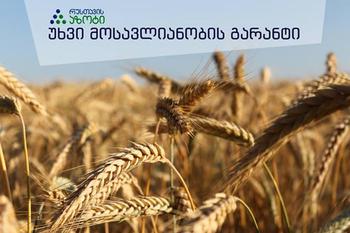
Wheat is one of the ancient crops. It is said that Georgia is home country of wheat crop, that is confirmed by Archaeological diggings in Kolkheti where burnt wheat was found (III millennium BC). At present there are kinds of wheat in Georgia that are absolutely unknown for other countries: Makha, Zanduri, Dika wheat and etc.
From cereal crops, wheat as main food product and is widely grown Georgia, as the crop has versatile application. It is one of the first cereal crops in our country.
The versatile climate and soil conditions of our country promoted variety of wheat species ,following local and selected species are sgrown in Georgia: Bezostaia 1,Motsinave,Akhaltsikhuri Tsiteli (red) Doli, Dolis Puri,Tetri (white) Doli,Tsiteli (red)Doli,Khulgo,Tavtukhi (Triticum Durum),”Shavphkha “ (Black Durum wheat).
- Autumn Wheat
Autumn wheat is grown more in the world than spring wheat .It may be explained by many advantages of autumn wheat. It is more productive than spring wheat, as it has longer vegetative period and uses autumn-winter and early spring humid conditions well, rapes earlier and is less damaged by hot winds and droughts (blighting).
Autumn wheat is more productive than autumn barley, rye and oats. Timely carried out agroechnical measures ensures rich yield of wheat.
- Ammonium Nitrate and Ammonium Sulfate application for Autumn Wheat Fertilization
Autumn wheat basically is grown in those regions where winters are worm. Seed germination begins at 1-2C0 temperature, but high temperature that is required for sprouting and growing process (12-15 C0 ) doesn’t mean that it should be sown at that time. Sowing should be carried out until temperature falls down, that means that sprouting process should be finished before vegetation period stops.
Autumn wheat is quite demanding to the soil. It grows well in neutral, weak acidic soils and areas with soils that are less liable to leaching (pH =6, 0-7, 5).Wheat is a long-day plant, with carpal root system, but still it has low ability to absorb nutrients from the soil, so in a short period of time, it has to get most part of required nutrient materials that is required for the processes from sprouting to flowering, during 1 or1,5 months period of time. At this period, from nutrient elements, nitrogen fertilizer demand by wheat is higher and it consumes about 100-120 kilos of pure substance of nitrogen.
For rich wheat harvest, during crop rotation it is very important wheat to be sown after well selected predecessor crop that is depended on farming methods of wheat growers, crop composition and etc.
Maize should be grown as one of the best predecessor crop of autumn wheat that is grown in any wheat growing region in the East and the West of Georgia. Sunflower is also a good predecessor crop, so first of all, the areas where Sunflowers are grown should be used for wheat sowing (Signagi,Sagarejo,Tsiteltskaro). In the East of Georgia, where irrigation system is accessible, it is appropriate to apply ammonium sulfate form of nitrogen fertilizer to nourish above-mentioned crops and autumn wheat. The fertilizer in this form remains in the soil, especially in black soils and doesn’t wash away with water. The norm of ammonium sulfate is N120 –180 kg/ha pure substance of nitrogen. Exact norm for concrete area can be set on the base of laboratory analysis.
In the west of Georgia as a predecessor of autumn wheat, maize lands are presented. In this case nitrogen norm is the same N120 –180 kg/ha but in ammonium nitrate form. Ammonia part of ammonium nitrate is tightly held by the soil and doesn’t wash away by water, while nitrate part is free and movable, so in terms of high moisture it may be washed away. In the West of Georgia, where lands are not irrigated such processes are less expected.
For predecessor cereal crops, in both east and west Georgia ,taking into account different climate and soil conditions the same nitrogen fertilizers are applied, just there is an important difference that required norm is more for predecessor crops and is N120 –200 kg/ha pure substance of nitrogen.
Lucerne and grain legumes are the best predecessor crops for autumn wheat. These crops by the means of root nodule bacteria make the soil rich with nitrogen compounds. In this case it is appropriate that nitrogen fertilizer norm to be reduced about to N80-100 kg/ha. Forms of fertilizers remain the same according to wheat growing regions.
The soil of fields that is freed from various perennial grasses has better physical – chemical properties and hard humpy structure. So the soil like that, is regarded as a good predecessor of autumn wheat. In this case it is recommended, that wheat should be fertilized with the same nitrogen fertilizers of N120-170 kg/ha norm.
Fallow land is highly efficient predecessor for cereals and especially for autumn wheat. In our country fallow lands are cultivated in east part of Georgia where lands are not irrigated and there is less atmospheric precipitation. Because of climate conditions there is no need of fallow land cultivation .So in view of the fact ,there is no danger of nitrate part leaching of ammonium nitrate, it will be better if the mentioned form of the fertilize is applied with norm of N60-100 kg/ha.
© copyright